
About this video
Turn competitor research into a qualified targeting shortlist by checking what the shopper is actually comparing, before you target a competitor's product. Chapters 0:00 Build a relevant competitor shortlist 0:39 Read the share metrics correctly 1:18 Match the product before the brand 1:59 Separate missing targets from missing reach 2:42 Qualify the launch conditions 3:24 Design a test you can interpret 4:06 Make the research usable by your team ScaleSKUs connects your Amazon Seller Central and Amazon Ads account to the AI you already use, such as Claude, ChatGPT or Gemini, over MCP. Ask in plain language, review the evidence, and approve every change. ▶ Start your 30-day free trial: https://scaleskus.com/mcp ▶ Hinglish mein dekhein: https://youtu.be/tcOUa2Ya19Q ▶ Full playlist: https://www.youtube.com/playlist?list=PLKDH05txqnqI
Transcript
A competitor attracts a large share of clicks. Should you target that product immediately? Start with what the shopper is actually comparing. A two hundred gram pack of walnut kernels and a one kilogram pack of walnuts in their shells solve different buying needs. In this lesson, we use ScaleSKUs to turn competitor research into a qualified targeting shortlist. Ask which competing products matter for your walnut queries, whether you already reach them, and what makes each candidate a good or poor fit.
Keep the output split into investigate, conditional, and reject. That gives every candidate a reason rather than simply producing a long list. The research identifies Tata Sampann, Happilo and Open Secret two hundred gram kernel products on the without-shell query. Tata Sampann has roughly twenty percent click share and nineteen point eight percent conversion share in the returned competition snapshot.
These are shares of activity in that source, not a nineteen point eight percent conversion rate for a campaign we could run. Ask what reporting period the snapshot covers. Here the exact competition dates are not exposed, while the query-demand week is September twentieth through twenty-sixth. Keep those sources labelled separately. Their different windows prevent us from treating them as one perfectly matched performance study.
Now check the candidate attributes. The three two hundred gram kernel products are relevant research candidates for a comparable kernel offer. A Plant Storey five hundred gram product is conditional on confirming our own five hundred gram product. In-shell products from Pro V, Nuts About You and Happilo are poor fits for this specific kernel comparison. Their brands may be familiar, but familiarity does not fix a product mismatch.
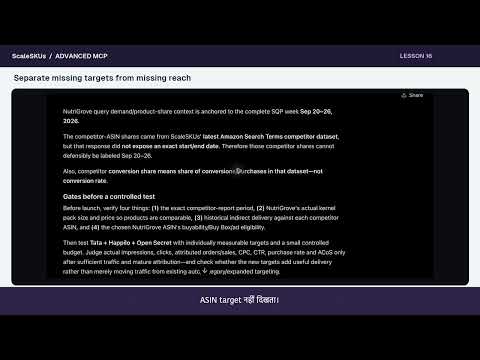
For a one kilogram kernel competitor, verify our matching pack before including it. The practical question is whether a shopper could reasonably compare the two offers, including quantity, product form, price and intended use. Next ask whether each candidate is already targeted. The checked data does not show an explicit direct Sponsored Products ASIN target for the three main candidates.
That is useful, but it does not establish that we never reach those product pages. Automatic campaigns, category targeting and expanded targeting can provide indirect coverage. Ask for actual product-placement delivery where available, alongside configured target entities. A target that is absent from one configuration table may still receive impressions through another route. Keep direct target coverage and observed reach in separate columns.
This avoids launching a duplicate test under the mistaken belief that the competitor is completely untouched. Before creating a campaign, turn each candidate into a launch checklist. Confirm the competitor product, the product you would advertise, actual pack and price, current eligibility, and existing delivery. Add the competition snapshot date if it can be obtained. Then define why a separate target would improve the current setup.
Perhaps it would isolate spend and outcomes for a relevant product comparison. That is a testable purpose. Simply saying the competitor is popular is not enough. A research-qualified candidate becomes launch-ready only when the offer fit and the measurement plan are clear. Missing attributes stay visible until someone verifies them. The next prompt should ask for a proposed test structure, not an automatic account-wide rollout.
Keep the selected targets distinguishable so you can review spend, clicks, orders and attributed sales by target. Establish the current baseline and account for existing automatic or category traffic. Set a budget and bid boundary that your business can support, using your actual margin and risk limits. Do not invent a universal advertising-cost target from the research table. Choose a review window that allows attribution to mature.
When you evaluate the test, compare relevant outcomes and total product performance, rather than celebrating a high click count on its own. Finish by requesting a compact decision table: competitor identifier, product form, pack size, relevance, existing direct coverage, possible indirect reach, missing evidence and next step. Include rejected candidates with a brief explanation so the same weak ideas do not return next week.
Assign the attribute checks to the right person, then bring the verified shortlist back for campaign design. For practice, take one of your own important searches and compare three competitor products. The skill is not finding the most competitors. It is explaining which comparison deserves a controlled advertising test, why it matters to your product, and what result would justify continuing it.
More videos
 4:57
Competitor Fit (Hinglish) · ScaleSKUs MCP Academy #16
1 Oct 2026
 4:48
Action Forensics · ScaleSKUs MCP Academy #20
1 Oct 2026
 4:41
Rule Coordination · ScaleSKUs MCP Academy #19
1 Oct 2026
 4:42
Scope Validation · ScaleSKUs MCP Academy #18
1 Oct 2026
 4:44
SP SB Intent · ScaleSKUs MCP Academy #17
1 Oct 2026
 4:35
Serving Diagnosis · ScaleSKUs MCP Academy #15
1 Oct 2026