
About this video
Sponsored Products converts on a search while Sponsored Brands shows nothing. Map searches across both ad types on the same dates to see whether it is a gap or a different job. Chapters 0:00 Map intent across ad formats 0:40 Read the Sponsored Products routes 1:22 Separate product intent within the query 2:00 Investigate an apparent Sponsored Brands gap 2:38 Confirm the campaign destination 3:21 Define a useful role for each format 4:01 Turn the map into a campaign brief ScaleSKUs connects your Amazon Seller Central and Amazon Ads account to the AI you already use, such as Claude, ChatGPT or Gemini, over MCP. Ask in plain language, review the evidence, and approve every change. ▶ Start your 30-day free trial: https://scaleskus.com/mcp ▶ Hinglish mein dekhein: https://youtu.be/ci_jW9GzEOk ▶ Full playlist: https://www.youtube.com/playlist?list=PLKDH05txqnqI
Transcript
Your Sponsored Products campaigns are converting on a search, but Sponsored Brands shows no activity for that same query. Is that a gap, or are those campaigns doing a different job? This lesson shows how to investigate before adding another campaign. Ask ScaleSKUs to map important walnut searches across Sponsored Products and Sponsored Brands, using the same settled date range.
Request the actual search terms, the campaign delivering them, and its intended product or landing destination. We will use September thirteenth through twenty-second. The goal is a useful coverage map, not a rule that every query must appear in every advertising format. For walnuts without shell, Campaign eleven records one thousand nine hundred and ninety-two clicks and five hundred and eight orders in the checked period.
Campaign thirty-one has eight clicks and no orders. For the broader walnut query, both Campaign eleven and Campaign four contribute orders. These routes are not automatically duplicates to eliminate. Different products, placements or targeting paths may explain them. Ask what each route advertises and whether its role is intentional. Preserve the exact query text when comparing reports. A keyword, a shopper search term and a product identifier are different entities, even when the names in your campaign structure look similar.
Size and product form change the meaning of the search. Five hundred gram searches appear across several campaigns, while in-shell demand follows a different pattern from without-shell demand. A one kilogram search has delivery, but our earlier checks have not verified the matching product pack. This is where a simple table of advertising cost can mislead you. Before deciding which campaign should own an intent, connect its actual advertised products to the shopper's need.
Use product attributes to confirm the match. Campaign names are clues, not proof that a particular pack or product is actually being advertised in that route. The Sponsored Brands search-term checks show no clicked rows for the seven walnut queries being reviewed. That is an observation worth investigating, not an automatic instruction to launch seven new targets. Ask whether there was any Sponsored Brands delivery at all, and which campaigns produced it.
The account has report activity, including two enabled campaigns with spend. So the whole format is not simply inactive. We need to understand why these particular queries are absent. This follow-up changes the question from, why is Sponsored Brands broken, to, are the existing campaigns meant to serve walnut shoppers in the first place? The active Sponsored Brands ad groups are named for figs and raisins.
Their recorded configuration includes a page-visit objective and sold-on-Amazon destination type. That suggests a different merchandising purpose, but we still need the actual creative, promoted products and landing page to confirm it. A current sync returning no keyword entities does not erase historical campaign delivery. Keep configuration evidence and report evidence separate. If the active campaigns promote figs and raisins, missing walnut search terms may be entirely expected.
A new walnut Sponsored Brands campaign would then be a deliberate expansion with its own business case, rather than a repair to those existing campaigns. A practical next prompt is: propose a role for each format based on the product, query intent and destination we can verify. Sponsored Products might capture a specific product purchase, while a Sponsored Brands experience could introduce a relevant range or brand story.
Those are possible roles, not exclusive capabilities or a universal template. Explain the customer experience you want, the products it should feature and how you will assess it. Avoid assuming that overlap is waste or that a second format guarantees incremental sales. Where incremental value matters, build a controlled comparison rather than attributing every new order to the new campaign.
Finish with a brief that separates existing coverage, verified product intent and proposed expansion. For every proposed campaign, include the search theme, eligible products, destination, creative requirements, budget boundary and review method. Mark any product or landing-page checks that remain open before creation. Keep the Sponsored Products routes that already perform unless the evidence gives a reason to change them.
For practice, choose one product family and map three important shopper intents across both formats. You should be able to explain why each campaign exists and where the shopper will land. That is more useful than simply having every query checked off in every format.
More videos
 4:42
SP SB Intent (Hinglish) · ScaleSKUs MCP Academy #17
1 Oct 2026
 4:48
Action Forensics · ScaleSKUs MCP Academy #20
1 Oct 2026
 4:41
Rule Coordination · ScaleSKUs MCP Academy #19
1 Oct 2026
 4:42
Scope Validation · ScaleSKUs MCP Academy #18
1 Oct 2026
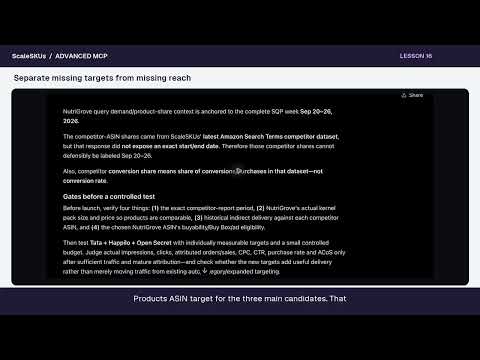 4:48
Competitor Fit · ScaleSKUs MCP Academy #16
1 Oct 2026
 4:35
Serving Diagnosis · ScaleSKUs MCP Academy #15
1 Oct 2026